20 Fantasy Football Stats That Actually Matter After Week 11
Twenty usage and efficiency numbers from Week 11 that should actually change your Week 12 lineup — from Parker Washington's buried air yards to the Dallas backfield's red-zone monopoly
Happy Thanksgiving to all that celebrate! I hope those of you celebrating have a brilliant day. For those of us in the UK, there’s the annual question of how much of Chiefs-Bills we can watch and still function tomorrow. Emmett Johnson has at least given us a good reason to stay up. Kansas City will be without Kenneth Walker III again, and Johnson is one of two rookie running backs I’d be very happy to start before we even get to Sunday.
The player I kept coming back to when I went through Week 11 was DeVonta Smith. If you waited weeks to get him back and got five catches for 41 yards, you’d be entitled to feel a little underwhelmed. Then you look at how often Joe Milton III tried to get him the football, and benching him in Dallas becomes a much harder decision to defend. There are a few of those this week, including a running back who went nowhere on 14 carries and a receiver who caught two of his ten targets.
The usage and efficiency figures below come from the Fantasy Points Data Suite through Week 11 unless otherwise stated. I’m using half-PPR for the offensive fantasy takeaways.
1. Parker Washington Had 17 Targets and 204 Incomplete Air Yards
Washington caught eight passes for 103 yards against the Giants, and there was still plenty left on the field. Trevor Lawrence threw 47 times, with 17 of those attempts going to Washington. NFL Pro credited him with 278 air yards, of which 204 came on incomplete passes. Think about how often Jacksonville must have been looking for him downfield for a receiver to clear 100 yards and still leave that much behind.
Jacksonville are heavy favourites against Tennessee, so projecting another 17 targets would be asking for trouble. Over ten games, though, Washington has averaged 2.77 yards per route run and drawn 14 red-zone targets. The Titans have been giving up 210 receiving yards per game to wide receivers. Lawrence could throw considerably less this week and Washington would still be my WR5.
2. Jonah Coleman Played 84% of the Snaps and Had 28 Touches
Coleman ran 24 times for 111 yards and three touchdowns against the Raiders. What I liked most came on the plays when Bo Nix kept the ball. Coleman ran a route on 49% of Denver’s dropbacks and caught four passes. When you account for the value of each carry and target, he took 93.6% of the backfield’s expected fantasy points.
Friday in Pittsburgh could be a much uglier game. Denver might only get one chance from the two-yard line all afternoon. I’d still have Coleman in my top six because the Broncos came out of their bye and trusted him to play in all situations. He can have a perfectly good fantasy week without getting anywhere near three touchdowns.
3. DeVonta Smith Saw 12 Targets in His First Game Back
Smith’s five catches for 41 yards against Pittsburgh were worth 6.6 half-PPR points. That’s a fairly miserable return on several weeks of patience. Across his five appearances this season, though, Smith has earned a target on 32% of his routes and accounted for 49.4% of Philadelphia’s air yards. The first thing the Eagles did when he was healthy was go straight back to him.
Joe Milton completed 11 passes against Pittsburgh. Smith caught five of them. There will be weeks when the quarterback play costs him, but Dallas came into Thanksgiving allowing the fourth-most fantasy points to receivers in the matchup data. I’ve got Smith at WR16. Asking him to convert a few more of those opportunities is a smaller leap than asking a fringe receiver to earn 12 in the first place.
4. Emmett Johnson Took 96.5% and 87.3% of Kansas City’s Expected Backfield Points
Those are Johnson’s shares in the two games Kenneth Walker III has missed. Johnson cleared 100 rushing yards in both and has reached 140 yards from scrimmage in three of his last four appearances. His season-long share of the backfield’s expected points is 33.2%. If you’re looking at that figure to decide where he belongs this week, most of the games in your sample describe a different job.
Walker has been ruled out for a third game, which puts Johnson in my top ten against Buffalo. The harder decision comes when Walker returns. Johnson has played well enough to earn more work, but these two games tell us very little about which back Andy Reid will trust at the goal line when both are available.
5. Jaxon Smith-Njigba Has 1,207 Yards on 295 Routes
Smith-Njigba is averaging 4.09 yards per route run through ten games. To put that in context, CeeDee Lamb has run 384 routes and has 1,108 yards. JSN has run 89 fewer routes and still leads Lamb by 99 receiving yards. It helps when 34.1% of the targets and 52.8% of the team’s air yards are coming your way.
There’s a fair argument that the ten touchdowns will cool. The Fantasy Points model puts the value of his receiving opportunities at 4.48 expected touchdowns. Where I’d push back is on using that gap to knock him down the rankings. He has 79 catches and is averaging 120.7 yards per game before you give him credit for scoring at all. He’s my WR1 against San Francisco.
6. CeeDee Lamb and George Pickens Accounted for 97.2% of Dallas’s Air Yards
Lamb took 44.4% against Tennessee and Pickens took 52.8%. Between them they also accounted for two out of every three targets. Nobody should expect that air-yard split to repeat every Sunday, but Pickens posted exactly 52.8% the week before as well. Dallas are giving both receivers chances downfield, and they’re doing it often enough for both to have a big game.
This is where I’d be careful about starting a third Cowboy because you like the matchup. Ryan Flournoy can help in a deeper league, but almost every yard Dak Prescott threw the ball downfield last week was intended for somebody else. Pickens can have a big week alongside Lamb. Flournoy needs rather more to go his way.
7. Javonte Williams Leads the League With 24 Carries Inside the Five
Williams has four more carries inside the five than Jahmyr Gibbs, his nearest challenger through Week 11. He’s scored ten rushing touchdowns, and the location and type of his carries have been worth 11.25 expected rushing touchdowns. A league-average return on those opportunities would have given him roughly another score.
Dallas have finished 35.7% of their offensive drives with a touchdown. That’s why I’m comfortable valuing Williams this highly at 4.04 yards per carry. He plays for an offence that keeps reaching the goal line and he’s usually the one getting the next hand-off. That’s a role I’d happily pay for through the fantasy playoffs.
8. Josh Allen Has 11 Rushing Touchdowns Against 14 Passing Touchdowns
In a league that awards four points for a passing touchdown, Allen has earned 56 points from throwing touchdowns and 66 from running them in. James Cook has ten rushing scores of his own. Anyone who drafted Cook can tell you how irritating it is when Buffalo get down to the one and leave the decision to Allen.
Kansas City came into the week allowing 12.2 fantasy points per game to quarterbacks. It’s a tough matchup, but an average across the quarterbacks they’ve faced can only tell you so much about a player who has carried 66 times in ten games. I’ve kept Allen at QB2.
9. Colston Loveland Has Drawn 12 Red-Zone Targets on 57 Total Looks
More than one in five of Loveland’s targets through Week 11 came inside the opponent’s 20. Last week illustrated how that helps him. Chicago threw just 23 times against New Orleans, Loveland caught all three of his targets, and one of them was a 15-yard touchdown.
The part worth watching beyond Thanksgiving is what happens between the 20s. He’s averaging 1.42 yards per route with a 17% team target share. That’s a more modest role than his TE2 ranking for Detroit might suggest. I loved the matchup with a Lions defence that’s been generous to tight ends. I’d want to see more ordinary first- and second-down targets before putting him there every week.
10. Jeremiah Trotter Jr. Made 33 Tackles in Three Games
Trotter played at least 90% of Philadelphia’s defensive snaps in each of those games and made a tackle on 18.1% of his snaps over the stretch. Thirteen tackles against Pittsburgh will get an IDP manager’s attention. Philadelphia continuing to leave him out there to call the defence tells you more about whether you can trust him next week.
Zack Baun is on injured reserve, and Trotter has the green dot. If you’ve been carrying an established linebacker who comes off on passing downs, I’d start Trotter ahead of him. With that much time on the field, he can afford a quieter tackle rate and still give you a perfectly good LB1 week.
11. Cincinnati’s Pass Rate Is 12.7 Percentage Points Above Expected
Pass rate over expected asks how often a team throws compared with what we’d expect in the same down, distance and game situation. Cincinnati are at plus 12.7 percentage points through ten games. Kansas City are second at plus 6.8. That’s a considerable gap between the two teams most willing to put the ball in the air.
I keep coming back to that when people worry the Bengals might get too far ahead of New Orleans for Tee Higgins to deliver. Joe Burrow has thrown 29 touchdowns, and Higgins is averaging 2.50 yards per route with a 35.2% share of the air yards. A Cincinnati lead doesn’t suddenly take the ball out of Burrow’s hands. I’m comfortable starting both Bengals receivers even if the Saints struggle to keep up.
12. Chase Brown Has Caught 52 Passes and Scored One Rushing Touchdown
Brown and Samaje Perine had six carries apiece against Washington. Brown gained six rushing yards, which is about as little fun as you can have watching your starting running back on a Monday night. He also drew eight targets. Over ten games he’s caught 52 balls for 276 yards, giving him 5.36 half-PPR points per game from receiving alone, before touchdowns.
The rushing work is a fair concern. Brown is averaging 3.76 yards per carry and the Bengals are happy to use Perine. New Orleans, though, have allowed 28.5 fantasy points per game to running backs in the matchup data. I’d go back to Brown as a low-end RB1, particularly given how often Cincinnati would prefer to throw him the ball anyway.
13. Cam Skattebo Played 85% of the Snaps Despite His Fumble
Fourteen carries for 34 yards and a fumble gave the Giants ample reason to look down the bench. Devin Singletary finished with two touches. Skattebo ran a route on 58% of dropbacks and his seven targets ranked second on the team. Jacksonville got the better of him as a runner, but the Giants kept finding work for him.
I’d be much more worried if Singletary had played the obvious passing downs after the fumble. That’s often where a young back starts to lose playing time, and it’s the work that can rescue a bad rushing day in half-PPR. Skattebo goes to Indianapolis with his top-ten case intact.
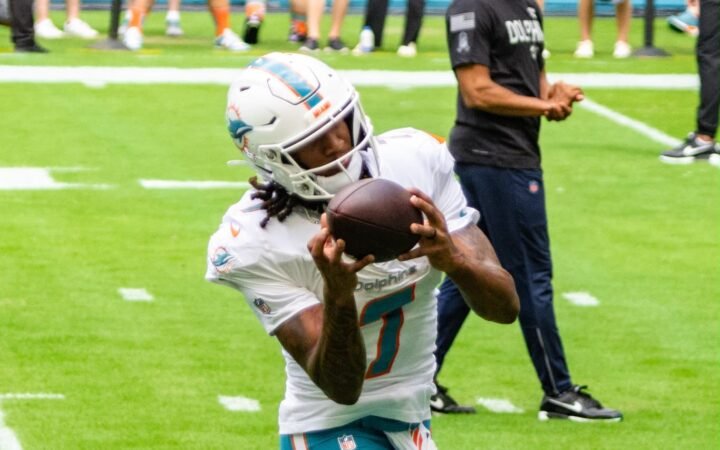
14. Caleb Douglas Had Ten Targets, 124 Air Yards and Two Catches
Miami kept trying to get Douglas the ball against Buffalo and got 30 yards for its trouble. What makes him interesting is the run of games leading into it. His target shares over the last three were 30.8%, 21.2% and 30.3%, and he took more than 40% of Miami’s air yards in all three.
There are going to be some ugly afternoons with a receiver whose average target is 13.67 yards downfield in this offence. If you’re choosing a third receiver against the Jets, though, I’d take Douglas over somebody who needs an injury ahead of him just to see six targets. His quarterback missed him plenty last week. I can live with that while he keeps looking for him.
15. Trey McBride Has 87 Catches Through 11 Games
CeeDee Lamb led the league with 88 receptions through Week 11. One catch behind him was a tight end playing for an Arizona offence scoring 1.63 points per drive. No tight end in NFL history has caught more passes through his team’s first 11 games of a season. McBride has also drawn 20 red-zone targets, so the Cardinals are still looking for him on the occasions they do get close.
His nine catches against the Chiefs produced just 54 yards. In half-PPR that’s 9.9 points without a touchdown, on an afternoon when he averaged six yards a catch. Every week somebody is trying to find a tight end on waivers who can get to ten points. McBride managed it to within a tenth without a single reception longer than nine yards.
16. Tommy DeVito Has Taken Four Sacks on 40 Dropbacks
DeVito’s work this season amounts to 32 pass attempts, 16 completions and 132 yards. It’s a small sample, and we’ll learn more about what New England want to do with him after a full week to prepare. Still, 4.13 yards per attempt and a sack on one in ten dropbacks make for a difficult starting point.
The Chargers get him at home in his first start of the season with Drake Maye sidelined. I have them at D/ST5. They can return a decent score through sacks and a low points total, which is a more comfortable position than needing somebody to take an interception back 60 yards.
17. Boye Mafe Has 9.5 Sacks in His First Ten Games for Cincinnati
Mafe had three sacks on Monday against Washington. The trouble with picking up a defensive lineman after a game like that is you can spend a month waiting for it to happen again. Take Monday out altogether, though, and Mafe had 6.5 sacks in his previous nine games. There was already plenty to like here.
The Week 12 projections have him playing around 47 snaps against New Orleans. That gives him enough opportunities to get home without needing another three-sack afternoon to justify a start. I’ve got him at DL9, and that’s where I’d use him if your league also lets you play him at linebacker.
18. Chuba Hubbard Has Had at Least 80% of Carolina’s Expected Backfield Points for Three Straight Games
Hubbard’s shares over Weeks 9, 10 and 11 were 94.2%, 86.2% and 80%. Against Baltimore he carried 27 times for 120 yards and two touchdowns. Four of his nine rushing scores have come in the last two games, but the workload was already there before the touchdowns started arriving in pairs.
He’s played 81.2% of Carolina’s snaps this season and run a route on 57.1% of their dropbacks. I don’t have to guess which Carolina back will play if they’re a score down in the fourth quarter on Monday. That’s a good reason to keep Hubbard in RB1 territory against Tampa Bay.
19. Ted Hurst Went From One Offensive Snap to Seven Targets
Hurst played one snap against Chicago. A week later in Detroit he played 44, led Tampa Bay with seven targets and caught five for 56 yards and two touchdowns. Going from the edge of the rotation to playing 64% of the offensive snaps is a much more interesting development than both of Baker Mayfield’s touchdown passes going his way.
There’s a catch here for anyone thinking of starting him on Monday. Three of his five receptions and his second score came on the final drive. I’d add him in a deeper league, then watch who Tampa put on the field for their first two series against Carolina. Another week of early involvement would do more for his December value than a late touchdown.
20. Tykee Smith Has Made Seven or More Tackles in Four of His Last Five Games
Smith had nine tackles in Detroit, six of them solo. For defensive backs, I like to look at what would have happened to the fantasy score if the interception or sack had never come. With Smith you can get a useful answer just by counting the tackles. He’s reached seven in four of his last five appearances ahead of Monday night.
The matchup brings us back to Hubbard. Carolina just handed him the ball 27 times, and a back who stays on the field when they throw gives a safety another chance to make a tackle underneath. Smith is my DB4 this week. If my matchup comes down to a defensive back on Monday, that’s the sort of work I’d want to have left.
One Bigger Trend Worth Watching
The question I’m asking about these backfields is who plays when the game stops going to plan? Denver didn’t need to throw much to Coleman while he was scoring three times, but he still ran routes on nearly half the dropbacks. The Giants got next to nothing from Skattebo on the ground and kept throwing to him. Brown split six carries apiece with Perine and still finished second on the team in targets.
That gives you something practical to look for in December. If your RB2 needs his team to lead, get inside the five and give him the carry, a couple of bad drives can wreck the whole afternoon. A back who plays on third-and-seven gets another chance before the punt team comes out. On a close start/sit call, that one extra down is often enough for me.
Takeaways
17 targets puts Parker Washington firmly in my WR1 group. 93.6% of Denver’s expected backfield points is why I’ll trust Jonah Coleman even if Pittsburgh keep him out of the end zone. The 12 targets DeVonta Smith saw in his first game back matter a great deal more to me than his 41 receiving yards.
The other two are 24 carries inside the five for Javonte Williams and 85% of the snaps for Cam Skattebo. One tells us exactly who Dallas want when they can see the goal line. The other tells us who the Giants still wanted after he’d put the ball on the floor. That’s the one I’d remember if somebody in your league is getting nervous about Skattebo.