NFL Coverages Explained: Cover 1
Based on Jeff Hafley's tendencies at Boston College and with the Green Bay Packers, Cover 1 is expected to be a staple of Miami's defense this season — here's how to recognize it on Sundays
This is the first in a new series breaking down NFL defensive coverages — starting with the ones you’ll actually see a lot of watching the Dolphins on Sunday’s.
Head coach Jeff Hafley’s history as a playcaller at Boston College and with the Green Bay Packers points to Cover 1 being a staple of Miami’s defense this season, so it’s a good place to start.
Hafley ran Cover 1 on 43.1% of plays as Boston College’s head coach in 2023, per PFF.
Here’s how to recognize it.
What is Cover 1?
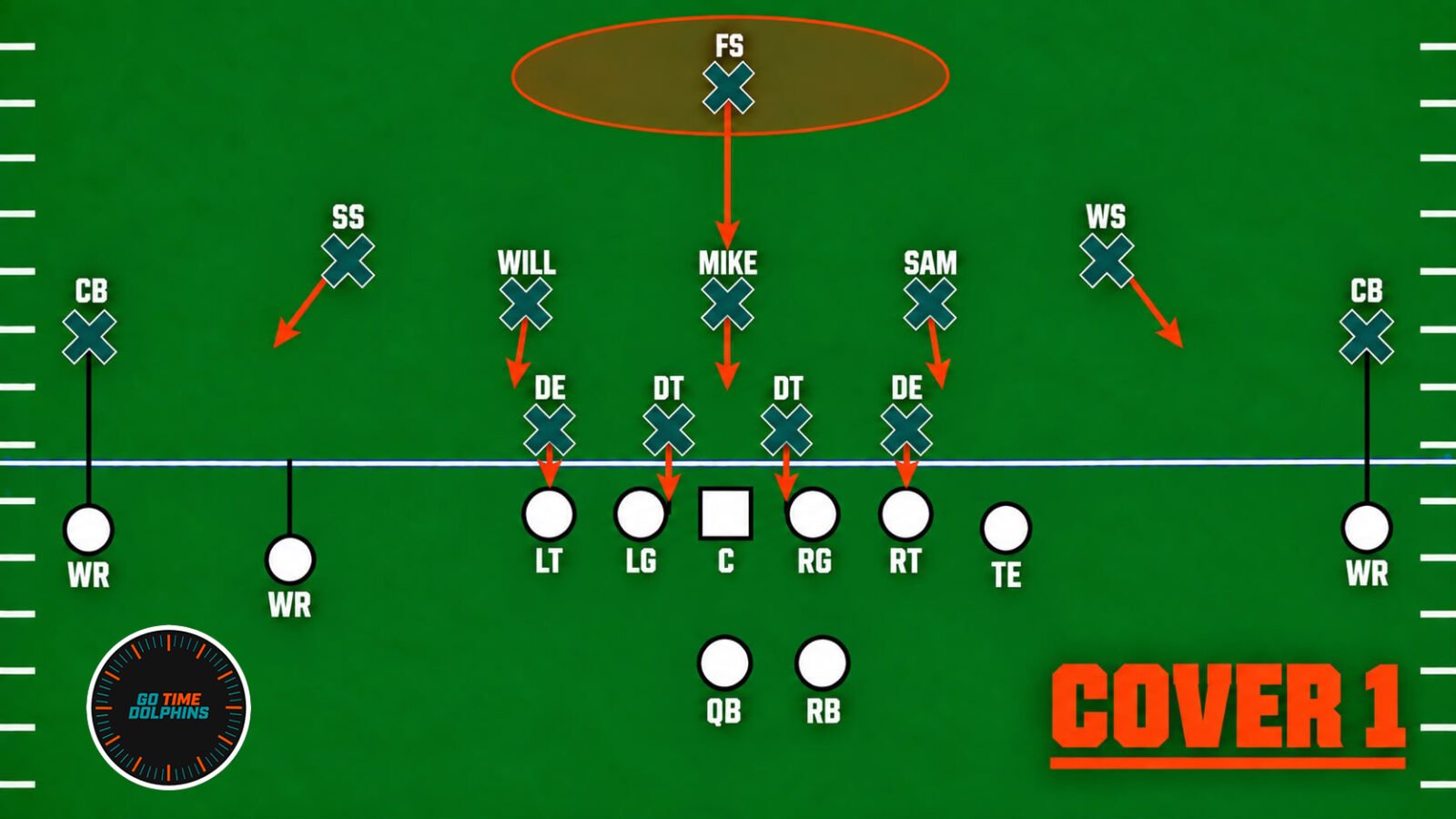
Cover 1 is a man coverage, meaning it’s man-to-man, and it’s called Cover 1 because there’s one safety playing in the middle of the field.
This coverage shuts down quick, short passes because defenders are glued to their receivers, leaving no easy throws for the quarterback.
But the weakness is clear: if a receiver beats their defender, there’s only one safety left to prevent a touchdown. Fast receivers can be a nightmare against Cover 1.
How to recognize it
You’ll spot Cover 1 by the single safety playing center field, with cornerbacks pressed tight on receivers. It’s also known as “man-free,” because of that free safety roaming deep.
Why it’s difficult for quarterbacks
Quarterbacks facing Cover 1 need pinpoint accuracy and timing — with defenders tightly covering receivers, throwing windows are tiny.
Smart quarterbacks will look for matchup advantages: maybe a speedy slot receiver against a slower linebacker, or a bigger receiver who can win jump balls.
Pre-snap motion can help identify the coverage, and the best quarterbacks will use their eyes to manipulate that single high safety — looking him off to create space for their intended target.
How to Beat Cover 1
The best place to attack Cover 1 is on the outside, away from where the deep safety can help knock down passes. Since defenses have help in the middle from the free safety and any underneath “hole” defender, offenses look to win their matchups on the perimeter instead.
A few answers show up consistently for offenses attacking Cover 1: pick plays, double moves, and routes that get the ball to playmakers on the move.
Pick plays involve receivers crossing paths downfield, aiming to create natural collisions between defenders that free up extra separation.
A common example is a spot route from the outside receiver, paired with a wheel route off his hip from the receiver lined up inside him.
Double moves give receivers another way to beat their matchup — selling a short or intermediate route before planting and breaking deep.
Sluggo (slant-and-go) and stutter (hitch-and-go) routes are two common examples that let receivers work in space on the perimeter.
Finally, routes that get the ball to receivers already moving are favorable against man coverage.
It’s much harder for a cornerback to tackle a receiver in motion than one catching the ball standing still.
Deep crossing routes, wheel routes, and out routes all let a receiver catch and quickly get moving again, maximizing yards after the catch.